


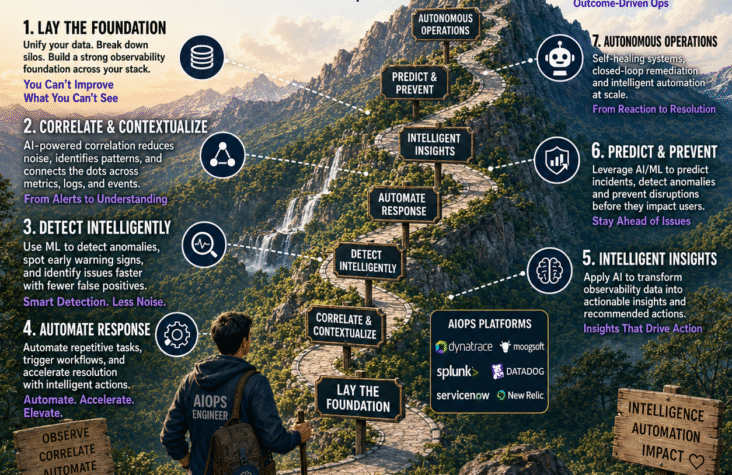
The AIOps Journey: From Alerts to Intelligent Operations
The world of IT operations is changing faster than ever.
A few years ago, organizations focused mainly on infrastructure automation, CI/CD pipelines, cloud adoption, and monitoring systems. But today, modern platforms generate massive volumes of logs, metrics, traces, events, alerts, and telemetry every second.
And the reality is:
Humans alone can no longer handle operational complexity at scale.
This is where AIOps enters the picture.
AIOps is not just another buzzword.
It is the evolution of modern operations.
It combines Artificial Intelligence, Machine Learning, Observability, Automation, and Cloud-Native Engineering to transform how organizations monitor, detect, respond, and optimize systems.
In simple terms:
AIOps helps organizations move from reactive operations to intelligent operations.
Why Traditional Operations Are No Longer Enough
Most operations teams today still struggle with:
- Alert fatigue
- Manual troubleshooting
- Too many monitoring tools
- Slow incident response
- False positives
- Lack of context across systems
- Increasing infrastructure complexity
As organizations scale across Kubernetes, microservices, multi-cloud environments, APIs, serverless platforms, and distributed architectures, operational data grows exponentially.
The result?
Teams spend more time reacting to incidents than preventing them.
Traditional monitoring tells you:
“Something is broken.”
AIOps helps answer:
- Why did it break?
- What caused it?
- What will break next?
- How can we prevent it automatically?
That is the real transformation.
The AIOps Journey
1. Lay the Foundation — Observability First
Every successful AIOps journey begins with observability.
You cannot improve what you cannot see.
Organizations first need visibility across:
- Infrastructure
- Applications
- Networks
- Databases
- Containers
- Kubernetes clusters
- Cloud services
- APIs
This involves collecting:
- Logs
- Metrics
- Traces
- Events
- Performance telemetry
Popular tools:
- Prometheus
- Grafana
- Datadog
- OpenTelemetry
- Splunk
- Dynatrace
Without clean and reliable data, AI models cannot generate meaningful insights.
Observability is the fuel of AIOps.
2. Correlate and Contextualize Data
One of the biggest operational challenges is noise.
A single outage can trigger:
- Hundreds of alerts
- Thousands of log entries
- Multiple incidents across tools
Traditional systems overwhelm engineers with disconnected information.
AIOps platforms correlate events intelligently.
Instead of seeing isolated alerts, teams begin seeing:
- Relationships
- Dependencies
- Root causes
- Service impact
- Incident patterns
This dramatically reduces alert fatigue and improves troubleshooting speed.
The shift happens from:
“Too much data”
to
“Actionable context.”
3. Detect Anomalies Intelligently
Traditional monitoring relies heavily on static thresholds.
For example:
- CPU > 80%
- Memory > 90%
- Error rate > 5%
But modern systems are dynamic.
AIOps introduces Machine Learning-based anomaly detection.
Instead of fixed thresholds, systems learn:
- Normal behavior patterns
- Traffic trends
- Seasonal variations
- Performance baselines
This enables:
- Early issue detection
- Faster incident identification
- Fewer false positives
- Smarter alerting
The result is a more proactive operations model.
4. Automate Response and Remediation
Detection alone is not enough.
The next stage is intelligent automation.
AIOps enables teams to:
- Trigger workflows automatically
- Restart failed services
- Scale infrastructure dynamically
- Open incident tickets
- Route alerts intelligently
- Execute remediation scripts
This reduces:
- Mean Time to Detect (MTTD)
- Mean Time to Resolve (MTTR)
- Manual operational overhead
The future is not just automated deployments.
It is automated operations.
5. Generate Intelligent Insights
AIOps transforms raw operational data into business intelligence.
Modern platforms can:
- Predict capacity requirements
- Identify reliability risks
- Detect unusual behavior
- Recommend optimizations
- Surface hidden trends
Operations teams stop acting like firefighters.
They become strategic enablers for the business.
This is where operations evolves into decision intelligence.
6. Predict and Prevent Incidents
The true power of AIOps lies in prediction.
Imagine knowing:
- A database will fail in 2 hours
- A service is degrading slowly
- Traffic spikes will overload infrastructure
- A deployment may introduce instability
Before customers are impacted.
Predictive operations changes the entire reliability model.
Organizations move from:
Reactive → Preventive
This is critical for:
- High-scale SaaS platforms
- Banking systems
- Healthcare applications
- E-commerce platforms
- Cloud-native ecosystems
Because downtime today directly impacts:
- Revenue
- Customer trust
- Brand reputation
7. Autonomous Operations — The Future State
The ultimate goal of AIOps is autonomous operations.
Systems that:
- Monitor themselves
- Detect anomalies automatically
- Correlate incidents intelligently
- Trigger remediation workflows
- Optimize resources dynamically
- Heal themselves with minimal human intervention
This is often called:
Self-Healing Infrastructure.
While many organizations are still early in this journey, the direction is clear.
Operations teams are evolving from:
Manual operators
to
Intelligent platform engineers.
AIOps + DevOps + Cloud = The Future Engineer
The industry is shifting rapidly.
Companies no longer want engineers who only:
- Write scripts
- Manage servers
- Create dashboards
They want engineers who can combine:
- DevOps
- Cloud
- Automation
- Observability
- AI/ML
- Platform Engineering
The future belongs to professionals who can build intelligent operational systems at scale.
This is why AIOps is becoming one of the most important skills in modern technology careers.
Final Thoughts
AIOps is not replacing engineers.
It is empowering engineers.
The goal is not to remove humans from operations.
The goal is to remove repetitive, reactive, and inefficient operational work.
The organizations that adopt intelligent operations early will gain:
- Better reliability
- Faster incident response
- Reduced operational costs
- Improved customer experience
- Greater engineering efficiency
The future of operations is not just monitoring dashboards anymore.
It is intelligent, predictive, autonomous operations.
And this journey has only just begun.